IEdge::GetConvexity
Use this property to get the Edge Convexity.
Edge Convexity Definition
Convexity is very important to operations such as blending. A blend on a convex edge removes material from the model; whereas a blend on a concave edge adds material to the model. Blending requires that edges have constant convexity over their entire length. (That is, an edge to be blended cannot have mixed-convexity.) If the convexity of an edge changes at some point in the edge, the edge must be split at that point. Boolean and Stitching Operations will split edges at points where the convexity changes.
The convexity of an edge is defined only for an edge:
- lying on two faces or
- having one face on both sides of it (edge convexity is not defined for non-manifold edges).
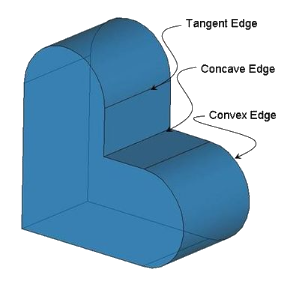
The convexity of an edge is defined with respect to the normals of the faces upon which it lies. Edges are typically classified as tangent, concave, or convex.
Tangent
If two faces meet tangentially, their common edge is termed a tangent edge. Tangent, concave, and convex edges are shown in the following image.
Mixed-Convexity
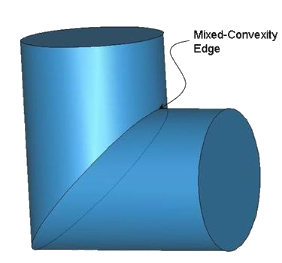
If the convexity of an edge changes over its length, the edge is said to have mixed-convexity. An edge with mixed convexity is shown in the following image.
Knife Edge
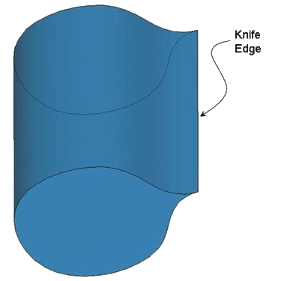
This edge is concave on its upper half and is convex on its lower half. If the two faces (or the face on both sides) of an edge meet tangentially and the directions into the face from the edge are parallel, then the edge may be called a knife edge.
Such an edge is shown in the following image.
Compatibility
Cimatron 2027 or later
Syntax
EdgeConvexity GetConvexity();
def GetConvexity() -> EdgeConvexity
Return Type
|
Return: EdgeConvexity |
oType - Return Edge Convexity |
Input Type
| Input: None | |
Remarks
None
Example
//PREREQUISITE - Cimatron must open and a Edge having id 30 must be present in the active part document
interop.CimAppAccess.AppAccess AppAcc = new interop.CimAppAccess.AppAccess();
interop.CimatronE.IApplication CimApp = (interop.CimatronE.IApplication)AppAcc.GetApplication();
interop.CimatronE.ICimDocument aDoc = CimApp.GetActiveDoc();
interop.CimMdlrAPI.IModelContainer aContainer = (interop.CimMdlrAPI.IModelContainer)aDoc;
interop.CimMdlrAPI.IMdlrModel aMdlrModel = (interop.CimMdlrAPI.IMdlrModel)aContainer.Model;
interop.CimMdlrAPI.IModel aModel = (interop.CimMdlrAPI.IModel)aMdlrModel;
int aEntityID = 30; //Id must the Id of edge type object
interop.CimBaseAPI.ICimEntity aEntity = aModel.GetEntityById(aEntityID, aModel);
interop.CimBaseAPI.IEdge aEdge = aEntity as interop.CimBaseAPI.IEdge;
EdgeConvexity aConvexity = aEdge.EdgeConvexity();
#PREREQUISITE - Cimatron must open and a Edge having id 30 must be present in the active part document
import clr
clr.AddReference("interop.CimAppAccess")
clr.AddReference("interop.CimatronE")
clr.AddReference("interop.CimServicesAPI")
clr.AddReference("interop.CimBaseAPI")
clr.AddReference("interop.CimMdlrAPI")
clr.AddReference("interop.CimNcAPI")
import interop.CimAppAccess
import interop.CimatronE
import interop.CimServicesAPI
import interop.CimBaseAPI
import interop.CimMdlrAPI
import interop.CimNcAPI
aAppAcc = interop.CimAppAccess.AppAccess()
aCimApp = interop.CimatronE.IApplication(aAppAcc.GetApplication())
aDoc = aCimApp.GetActiveDoc()
aContainer = interop.CimMdlrAPI.IModelContainer(aDoc)
aMdlrModel = interop.CimMdlrAPI.IMdlrModel(aContainer.Model)
aModel = interop.CimMdlrAPI.IModel(aMdlrModel)
aEntityId = 30 # Entity must be edge type
aEntity = aModel.GetEntityById(aEntityId, aModel)
aEdge = interop.CimBaseAPI.IEdge(aEntity)
aTol = 0.0;
aConvexity = aEdge.EdgeConvexity()
